This product was not featured by Product Hunt yet. It will not be visible on their landing page and won't be ranked (cannot win product of the day regardless of upvotes).
SB-GIMMEL
Pure math 17th-century mechanical ring inside a shader
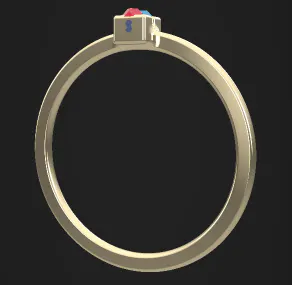
An interactive digital reconstruction of a rare 17th-century Gimmel wedding ring, engineered entirely within a single fragment shader using mathematical Raymarching. No 3D models (.glb/.obj), no image textures, no external canvas assets. Features fluid kinematic unfolding mechanics, anatomical D-shape comfort-fit gold profiles, and procedural Champlevé enamel monograms rendered at a rock-solid 60 FPS across all modern mobile and desktop viewports.
Hi Product Hunt community! 👋
I’ve always been fascinated by historical jewelry mechanics, especially the Gimmel rings of the 17th century—intricate tokens of intimacy featuring interlocking bands that pivot open to reveal hidden internal vows. When I saw modern web interpretations of high-end jewelry, I noticed everyone relied on the same formula: sculpting a heavy polygon mesh in Blender, packing it into a .glb file, and loading it via a basic Three.js wrapper.
I wanted to challenge that status quo. I wanted to see if absolute luxury could be rendered out of thin air, using nothing but pure vector equations inside a single WebGL2 fragment shader.
The biggest monster in this journey was sub-pixel aliasing. On a micro-scale, rotating gold edges and thin lines turn into a jaggy, pixelated mess. I ran a brutal gauntlet of anti-aliasing techniques to crush this noise without breaking the performance:
1. Multi-pass Supersampling (SSAA Rig) — It delivered gorgeous boundaries but quadrupled the pixel math, choking mobile GPUs.
2. Screen-Space FXAA Filters — It smoothed the edges on the fly but blurred the crisp specular highlights of the 18K gold material, destroying the premium feel.
3. My Geometric Fillet Solution — The breakthrough was native. I completely rebuilt the ring cross-section into a curved D-shape anatomy using a cosine arc distortion, expanding the physical radius of the mathematical blend fillets. By allowing the directional studio light rig to softly roll over calculated microscopic bevels rather than zero-width mathematical lines, the edge pixels stopped exploding natively. The silhouettes became flawlessly smooth at 60 FPS without a single heavy post-processing pass.
Instead of pixelated flat image textures, the hidden "S" and "B" monograms are rendered via direct procedural vector math, mimicking the authentic royal Champlevé enamel technique where the glass lacquer settles smoothly inside the solid metal matrix.
This project is a testament to what happens when you push custom interactive graphics to their absolute technological limit. I build exclusive features for websites of any complexity (создаю эксклюзивные фишки для сайтов любой сложности) to help brands stand out with unique, high-performance visual footprints. My full contact details are available right in my profile—let's create something extraordinary together.
I’d love to hear your thoughts, feedback, and hardware performance results in the comments below! Thank you for the support! ⚜️
the fact that this is a whole wedding ring built from math with no models or textures is genuinely wild, and it runs smoothly on my phone. the little unfolding animation when you tap is such a satisfying detail.
About SB-GIMMEL on Product Hunt
“Pure math 17th-century mechanical ring inside a shader”
SB-GIMMEL was submitted on Product Hunt and earned 0 upvotes and 3 comments, placing #144 on the daily leaderboard. An interactive digital reconstruction of a rare 17th-century Gimmel wedding ring, engineered entirely within a single fragment shader using mathematical Raymarching. No 3D models (.glb/.obj), no image textures, no external canvas assets. Features fluid kinematic unfolding mechanics, anatomical D-shape comfort-fit gold profiles, and procedural Champlevé enamel monograms rendered at a rock-solid 60 FPS across all modern mobile and desktop viewports.
SB-GIMMEL was featured in Design Tools (263.5k followers), Developer Tools (521.7k followers) and Digital Art (2.6k followers) on Product Hunt. Together, these topics include over 137.2k products, making this a competitive space to launch in.
Who hunted SB-GIMMEL?
SB-GIMMEL was hunted by Stephaniia B.. A “hunter” on Product Hunt is the community member who submits a product to the platform — uploading the images, the link, and tagging the makers behind it. Hunters typically write the first comment explaining why a product is worth attention, and their followers are notified the moment they post. Around 79% of featured launches on Product Hunt are self-hunted by their makers, but a well-known hunter still acts as a signal of quality to the rest of the community. See the full all-time top hunters leaderboard to discover who is shaping the Product Hunt ecosystem.
Want to see how SB-GIMMEL stacked up against nearby launches in real time? Check out the live launch dashboard for upvote speed charts, proximity comparisons, and more analytics.

 Stephaniia B.