This product was not featured by Product Hunt yet. It will not be visible on their landing page and won't be ranked (cannot win product of the day regardless of upvotes).
Product upvotes vs the next 3
Waiting for data. Loading
Product comments vs the next 3
Waiting for data. Loading
Product upvote speed vs the next 3
Waiting for data. Loading
Product upvotes and comments
Waiting for data. Loading
Product vs the next 3
Loading
ars
Learns your coding style and enforces it in new projects
An engine that learns your coding style from past projects, turns it into agent skills, and proves coding agents follow it. Claude Code today; Codex and other agents next.
Coding agents write competent code that doesn’t look like the rest of your codebase. The usual fix is a hand-written conventions file, but you’re guessing at your own conventions, and nothing tells you whether the agent follows them.
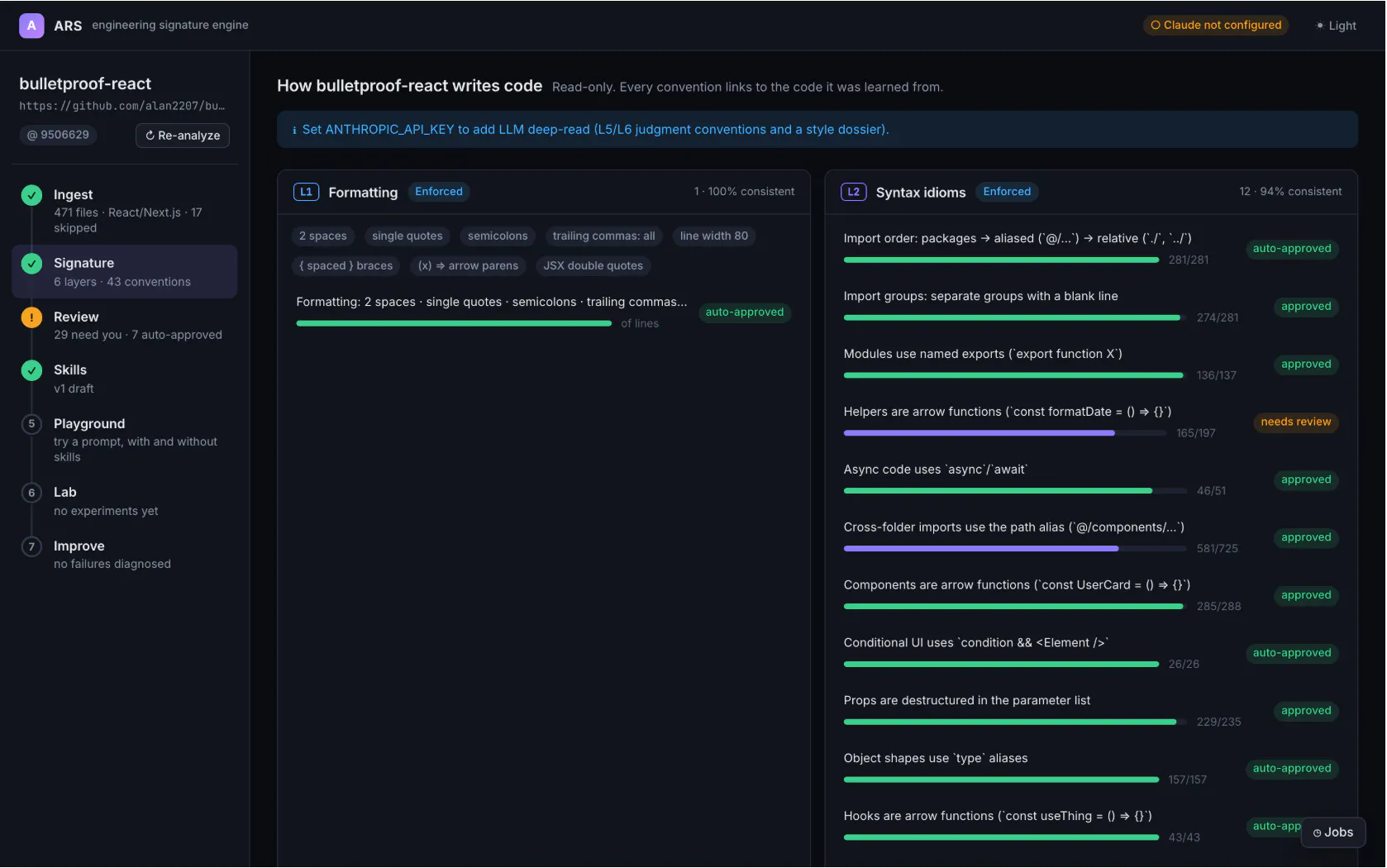
ARS, an open source engine treats this as a measurement problem. It mines a reference repo for conventions: AST statistics for syntax and naming, the import graph for architecture, and an optional LLM pass for higher-level patterns. Each convention becomes an executable rule with evidence and exceptions (e.g. “hooks live in src/hooks/, 47/49 files”), and each rule tests itself by planting a violation and checking it’s caught. You review the rules; ARS generates Claude Code skills and an edit hook.
The same rules then score agent output on unseen tasks:
rebuilding held-out files from the repo
new apps in unrelated domains, with hidden acceptance tests
a blind judge picking which file is real
Each runs three ways: no skills, a generic guide of the same length (so gains aren’t just from a longer prompt), and your skills, with repeats and bootstrap CIs. Failing rules are diagnosed with counterfactual reruns, and fixes only land if a regression gate passes.
[Your real result here]
Limitations: TypeScript/React only for now, and the LLM pass can suggest plausible-but-wrong rules, which is why review is required.
Local-first, Apache-2.0. Codex and other agents are next. I’d especially love feedback on the measurement design.
About ars on Product Hunt
“Learns your coding style and enforces it in new projects”
ars was submitted on Product Hunt and earned 0 upvotes and 1 comments, placing #138 on the daily leaderboard. An engine that learns your coding style from past projects, turns it into agent skills, and proves coding agents follow it. Claude Code today; Codex and other agents next.
On the analytics side, ars competes within Open Source, Developer Tools, Artificial Intelligence and GitHub — topics that collectively have 1.1M followers on Product Hunt. The dashboard above tracks how ars performed against the three products that launched closest to it on the same day.
Who hunted ars?
ars was hunted by Wasajja Patrick. A “hunter” on Product Hunt is the community member who submits a product to the platform — uploading the images, the link, and tagging the makers behind it. Hunters typically write the first comment explaining why a product is worth attention, and their followers are notified the moment they post. Around 79% of featured launches on Product Hunt are self-hunted by their makers, but a well-known hunter still acts as a signal of quality to the rest of the community. See the full all-time top hunters leaderboard to discover who is shaping the Product Hunt ecosystem.
For a complete overview of ars including community comment highlights and product details, visit the product overview.

 Wasajja Patrick

Coding agents write competent code that doesn’t look like the rest of your codebase. The usual fix is a hand-written conventions file, but you’re guessing at your own conventions, and nothing tells you whether the agent follows them.
ARS, an open source engine treats this as a measurement problem. It mines a reference repo for conventions: AST statistics for syntax and naming, the import graph for architecture, and an optional LLM pass for higher-level patterns. Each convention becomes an executable rule with evidence and exceptions (e.g. “hooks live in src/hooks/, 47/49 files”), and each rule tests itself by planting a violation and checking it’s caught. You review the rules; ARS generates Claude Code skills and an edit hook.
The same rules then score agent output on unseen tasks:
rebuilding held-out files from the repo
new apps in unrelated domains, with hidden acceptance tests
a blind judge picking which file is real
Each runs three ways: no skills, a generic guide of the same length (so gains aren’t just from a longer prompt), and your skills, with repeats and bootstrap CIs. Failing rules are diagnosed with counterfactual reruns, and fixes only land if a regression gate passes.
[Your real result here]
Limitations: TypeScript/React only for now, and the LLM pass can suggest plausible-but-wrong rules, which is why review is required.
Local-first, Apache-2.0. Codex and other agents are next. I’d especially love feedback on the measurement design.